
The Integration Paradox: Why Connected Systems Create Disconnected Organizations — And How to Build Technology That Brings People Together
There is a village in southern Spain where something strange happened.
For centuries, the village had no roads connecting it to the outside world. People walked. They rode donkeys. They knew every neighbor by name. They gathered in the plaza every evening to share news, gossip, life.
Then the government built a highway.
Suddenly, the village was connected. To Madrid. To Barcelona. To the entire country. Commerce flowed in. Tourists arrived. Money came.
But something else happened.
The young people left. Why stay when the city was only two hours away? The plaza emptied. Why gather when you could watch television instead? Neighbors stopped knowing each other. Why bother when you could drive to the supermarket in the next town?
The highway connected the village to everything.
And disconnected it from itself.
The Promise of Integration
Every ERP sales pitch includes the same promise:
“One unified system. All your data connected. Complete visibility across the organization.”
It sounds beautiful. It sounds logical. It sounds like exactly what every fragmented, spreadsheet-drowning company needs.
And so companies integrate.
They connect the ERP to the CRM. The CRM to the e-commerce platform. The e-commerce platform to the warehouse system. The warehouse system to the shipping carriers. The shipping carriers to the tracking apps. The tracking apps to the customer portals.
Lines drawn on architecture diagrams. APIs configured. Data flowing in every direction.
And then something unexpected happens.
Nothing gets better.
Or worse — things get worse.
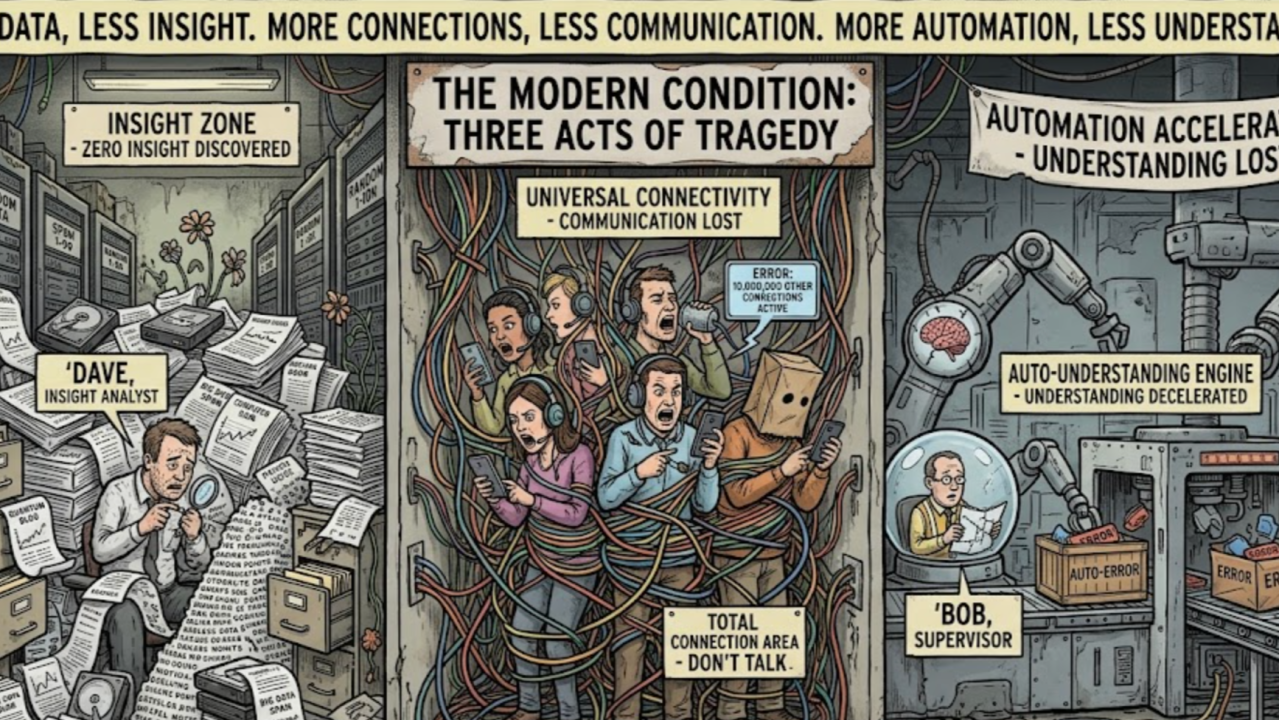
More data, but less insight. More connections, but less communication. More automation, but less understanding.
This is the Integration Paradox.
And until you understand it, you will keep building bridges that lead nowhere.
The Four Diseases of Over-Integration
I have seen integration fail in many ways. But the failures cluster into four patterns. Four diseases that infect connected organizations.
Learn to recognize them.
Disease #1: The Data Flood
Symptoms:
Everyone has access to everything. Dashboards multiply like rabbits. Reports arrive by the dozen. Inboxes overflow with automated notifications.
And yet, somehow, no one knows what’s actually happening.
The cause:
Integration without curation. Every system sharing everything with every other system. No one asking: “Who needs this? Why? When?”
I worked with a company that integrated their ERP with fourteen other systems. Every morning, managers received sixty-three automated reports. The average time spent reading these reports? Seven minutes.
Seven minutes for sixty-three reports.
Which means they read nothing. They skimmed. They searched for red flags. They missed everything that wasn’t screaming.
The cure:
Less data, more intelligence.
Before you build any integration, ask: “What decision does this enable? Who makes that decision? What is the minimum data they need?”
Not the maximum. The minimum.
Integration should be a filter, not a firehose.
Disease #2: The Accountability Fog
Symptoms:
When something goes wrong, no one knows who is responsible. When data is incorrect, everyone points to another system. When a customer complains, the investigation spans six departments and three weeks.
The cause:
Integration without ownership. Data flows from system to system, transforming along the way, until no one knows where it originated or who is responsible for its accuracy.
I call this “data laundering.”
A number starts in the CRM. It flows to the ERP. It gets modified by a workflow. It appears on a report. The report shows something impossible. Everyone shrugs. “The data must be wrong somewhere.”
Where? No one knows. No one owns it. Everyone blames the integration.
The cure:
Golden records and clear ownership.
For every piece of data, define:
- The system of origin (where it is created)
- The system of record (where the “truth” lives)
- The owner (the human being accountable for its accuracy)
Data can flow anywhere. But truth must have a home.
Disease #3: The Speed Trap
Symptoms:
Things happen faster. Orders flow instantly from website to warehouse. Invoices generate automatically. Data synchronizes in real-time.
But errors also flow instantly. Mistakes propagate automatically. Problems synchronize in real-time.
One wrong entry cascades through fourteen systems before anyone notices. By the time you find it, the damage is everywhere.
The cause:
Integration without checkpoints. The assumption that faster is always better. The elimination of every pause, every review, every human moment of reflection.
Real-time is a feature.
But real-time is also a risk.
The cure:
Strategic friction.
Not everything should be instant. Some data needs to pause. Some transactions need review. Some integrations should run hourly, not immediately.
Ask: “What is the cost of a one-hour delay versus the cost of an instant error?”
Often, the delay costs nothing. The error costs everything.
Build checkpoints into your integration architecture. Staging areas where data lands before it moves. Validation rules that catch impossibilities. Human approvals for high-stakes transactions.
Speed without control is not efficiency. It is chaos accelerated.
Disease #4: The Human Bypass
Symptoms:
Departments stop talking to each other. Why call the warehouse when you can check the system? Why meet with sales when you can see the pipeline on your dashboard? Why walk to the production floor when you have real-time OEE metrics on your phone?
Communication becomes optional. Relationships atrophy. The organization becomes a collection of individuals staring at screens, connected to systems, disconnected from each other.
The cause:
The belief that information equals understanding. The assumption that if data flows, communication has occurred.
But data is not communication.
Communication is meaning. Context. Nuance. The tone of voice that tells you the warehouse manager is worried even though the numbers look fine. The raised eyebrow in the meeting that suggests the sales forecast is optimistic. The casual conversation that reveals a supplier is in financial trouble.
Systems cannot capture this. Integrations cannot transfer this.
Only humans can.
The cure:
Integration that enhances human connection, not replaces it.
The best integrations do not eliminate meetings. They make meetings better. Instead of spending an hour gathering data, you spend an hour discussing what the data means.
The best dashboards do not replace conversations. They spark them. “I noticed this number looks odd. Can we talk?”
Technology should be the starting point of human interaction. Not the ending point.
The Integration Philosophy
Before you connect anything, answer these questions:
Question 1: What problem are we solving?
Not “what would be nice to have.” What actual problem, experienced by actual people, are we fixing?
If you cannot articulate the problem in one sentence, you are not ready to integrate.
Bad answer: “We want all our systems to talk to each other.”
Good answer: “Sales commits delivery dates without knowing production capacity. This integration will give them real-time availability.”
Question 2: Who benefits, and how will they use it?
Integration for its own sake helps no one. Every connection should have a beneficiary. A human being whose work becomes better.
Name them. Interview them. Understand their workflow. Design the integration around their needs, not around technical elegance.
Question 3: What is the cost of failure?
Every integration creates dependency. When system A depends on system B, the failure of B becomes the failure of A.
The more integrations, the more dependencies. The more dependencies, the more fragility.
Ask: “If this integration fails at 2 AM on the busiest day of the year, what happens? Can we survive? Can we work around it? Or does everything stop?”
Design for failure. Build fallbacks. Create manual overrides. Assume things will break, because they will.
Question 4: Who owns this integration?
Not which system. Which person.
When data is wrong, who investigates? When the integration breaks, who fixes it? When requirements change, who decides what to modify?
Integration without ownership is integration without accountability. And accountability is everything.
Question 5: How will we know it’s working?
Define success before you build.
What metrics will improve? By how much? By when?
If you cannot measure the impact, you cannot justify the investment. And you cannot course-correct when things go wrong.
The Integration Hierarchy
Not all integrations are equal. Some are essential. Some are helpful. Some are vanity.
Here is how I prioritize:
Level 1: The Foundation (Must Have)
These integrations are non-negotiable. Without them, your core business breaks.
- ERP ↔ Financial System: If these don’t match, your books are fiction.
- ERP ↔ Bank: Payments must flow. Reconciliation must work.
- ERP ↔ Tax Authority: VAT compliance. Statutory reporting. No choice.
Build these first. Build them strong. Test them exhaustively.
Level 2: The Operations (Should Have)
These integrations make your operations efficient. Life is possible without them, but painful.
- ERP ↔ Warehouse/WMS: Inventory accuracy. Picking efficiency.
- ERP ↔ Production Systems: Shop floor data. Machine integration.
- ERP ↔ Procurement Platforms: Supplier communication. PO automation.
Build these second. Validate that Level 1 is stable before you add complexity.
Level 3: The Intelligence (Nice to Have)
These integrations make you smarter. They enable better decisions.
- ERP ↔ Business Intelligence: Dashboards. Analytics. Reporting.
- ERP ↔ Planning Systems: Demand forecasting. S&OP.
- ERP ↔ Quality Systems: Statistical analysis. Trend detection.
Build these when you have capacity. Do not sacrifice stability for insight.
Level 4: The Experience (Competitive Advantage)
These integrations differentiate you. They create customer value.
- ERP ↔ Customer Portals: Self-service. Visibility. Engagement.
- ERP ↔ E-commerce: Real-time inventory. Dynamic pricing.
- ERP ↔ CRM: 360-degree customer view. Personalization.
Build these when Levels 1-3 are mature. These are the integrations that impress. But impressive on a shaky foundation is a house of cards.
The Integration Architecture Principles
When you design integrations, follow these principles:
Principle 1: Loose Coupling
Systems should connect, but not depend.
If system B goes down, system A should degrade gracefully, not crash completely. Queues. Buffers. Retry logic. Fallback procedures.
The goal is resilience, not just connectivity.
Principle 2: Single Source of Truth
Every data element should have one — and only one — authoritative source.
The customer’s address lives in the CRM. Period. The ERP may have a copy, but when they conflict, CRM wins.
Document this. Publish it. Enforce it.
Data chaos begins when two systems both believe they are right.
Principle 3: Meaningful Transformation
When data moves between systems, it should gain meaning, not lose it.
A sales order in the CRM becomes a production order in the ERP. A production order becomes a shipping request in the WMS. Each transformation adds context appropriate to the receiving system.
If data arrives in the same form it left, ask: why are we doing this?
Principle 4: Audit Everything
Every transaction should leave a trail.
What was sent? When? By which system? What was received? Did it succeed? If it failed, why?
Without audit trails, troubleshooting is archaeology. With them, it is science.
Principle 5: Design for the Exception
The happy path is easy. Customer orders product. Product ships. Invoice sends. Payment receives.
But what about returns? Partial shipments? Cancelled orders? Credit notes? Disputes?
Integrations that only handle the happy path create operational nightmares. Design for the exceptions from the beginning. They are not edge cases. They are reality.
The Human Integration
Here is something the technologists forget:
The most important integration is between people.
Systems can move data. Only humans can create understanding.
The sales team and the operations team can share a database. But if they never meet, never discuss, never build relationships — the data is meaningless. It is numbers without context. Metrics without meaning.
I have seen companies with perfect technical integration and terrible organizational alignment. The CRM and ERP sync flawlessly. But sales and operations hate each other. They interpret the same data differently. They blame each other for every problem.
The integration made the conflict more efficient, not less.
How to build human integration:
Joint KPIs
Do not let departments optimize in isolation. Create metrics that require collaboration.
“On-time delivery” is not just an operations metric. It is sales (for promising correctly) + production (for manufacturing on time) + logistics (for shipping efficiently) + finance (for invoicing promptly).
When the metric is shared, the conversation is shared.
Cross-Functional Rituals
A weekly meeting where sales, operations, and finance sit in the same room. Not to present slides. To discuss reality.
“Here’s what we see happening. Here’s what concerns us. Here’s what we need from each other.”
No agenda except alignment. No outcome except understanding.
Rotation Programs
Send your best salesperson to work in the warehouse for a week. Send your production planner to ride along with delivery drivers. Send your finance analyst to shadow customer service.
Nothing creates empathy like experience. Nothing breaks silos like walking in someone else’s shoes.
Shared Celebrations
When you win a big customer, who celebrates? Just sales?
No. Everyone who contributed. The team that will manufacture. The team that will ship. The team that will support.
Victory is shared. So is the journey.
The Integration Audit
Answer these questions about your current integrations:

If you answered “No” or “Partial” more than twice, you have integration debt. It will come due eventually. Better to address it proactively than in a crisis.
The Story of Two Integrations
Let me tell you about two companies that integrated the same two systems.
Company A hired the cheapest consultants. They built the integration in four weeks. It moved data from the e-commerce platform to the ERP. Orders flowed automatically. Everyone was happy.
Until Christmas.
Order volume tripled. The integration, designed for normal load, buckled. Orders queued. Timeouts multiplied. Some orders made it through. Some didn’t. Some duplicated. By December 27th, the company had shipped three orders to the same customer, missed a hundred others, and sent invoices for products that never left the warehouse.
It took four months to untangle the mess. Customer trust never fully recovered.
Company B spent more time and money. They built the same integration with queues and buffers. They tested with 10x normal volume. They created a manual fallback procedure: if the integration fails, here’s how we process orders by hand. They documented everything. They assigned an owner.
Their Christmas was busy. The integration slowed but didn’t break. The team monitored closely. A few orders needed manual intervention. By January, they had a list of improvements for next year.
Same integration. Different philosophy.
The first company built a connection.
The second company built a capability.
The Paradox Resolved
So how do you integrate without disconnecting?
Here is the answer:
Integration is not the goal. Capability is the goal.
The question is not: “How do we connect these systems?”
The question is: “How do we build an organization that can respond to customers faster, operate more efficiently, and adapt to change more gracefully?”
Sometimes that requires integration. Sometimes it requires simplification. Sometimes it requires replacing three systems with one. Sometimes it requires adding human checkpoints to automated processes.
The technology serves the capability. The capability serves the strategy. The strategy serves the customer.
When you lose this hierarchy, you build highways that destroy villages.
When you remember it, you build connections that make everyone stronger.
The Invitation
Look at your organization tomorrow.
Not at your architecture diagrams. At your people.
Watch how they interact. Listen to how they talk about other departments. Notice whether they collaborate or compete. Whether they share or hoard. Whether they help or blame.
This is your real integration status.
And no API can fix it.
Only leadership can. Only culture can. Only the deliberate, patient work of building trust across boundaries.
Systems can accelerate connection.
But only humans can create it.
What integration have you built that actually brought people closer together? Or one that drove them apart? Share your story in the comments. The lessons are in the details.